QUOTATION
EXERCISES
(class 3, Homework 3)
Note:
(1) assignments appear in the syllabus on the day assigned, not the day due
(2)
You
must submit your written work by blackboard's dropbox. If you don't
know how, see here
blackboard / dropbox
(3)
BE SURE TO FOLLOW THE FILE-NAMING CONVENTIONS FOR THIS COURSE (5% penalty
if you do not).
All files should be saved on your computer as:
your last name, followed by an underscore ("_"), followed
by the first two letters of your first name, followed
by an underscore ("_"), followed by the assignment
number. So if a student named Saddam Hussein were to submit assignment
number 3, the file name would be:
hussein_sa_3.doc
THIS
IS ASSIGNMENT 3
Quotation Exercises
After having
read the explanation of how to use evidence and quotations in your
paper, do the three part (A, B & C) exercise that follows. Be
sure that you have done all three parts; do not stop until you see
"END OF ASSIGNMENT."
Be sure to contact Prof. Umbach if you
have any questions
| Who was Ibn Battuta? |
| Born
in Morocco, Ibn Battuta was the only medieval traveler who is
known to have visited the lands of every Muslim ruler of his
time. He also traveled in Ceylon (present Sri Lanka), China
and Byzantium and South Russia. The mere extent of his travels
is estimated at no less than 75,000 miles, a figure which is
not likely to have been surpassed before the age of steam. He
is a useful source of information on West Africa for the period
before extensive contact with Europe. More
on Ibn Battuta |
Exercise A:
Read this passage from p. 303 of the book The Adventures of Ibn Battuta, A Muslim Traveler of the 14th Century (1986) by Ross Dunn, a historian at the University of California, and then answer the 2 short questions that follow the passage by Dunn:
Ibn Battuta ended a sojourn of a little more than eight months in the capital in a state of ambivalence over the qualities of Malian culture. On the one hand, he respected [the ruler's] just and stable government and the earnest devotion of the Muslim population to their mosque prayers and Koranic studies. "They place fetters on their children if there appears on their part a failure to memorize the Koran," he reports approvingly, "and they are not undone until they memorize it."
Fetters? ibn Battuta here refers to iron clamps on the leg; see whole passage from Ibn Battuta On the other hand he [criticized] the Sudanese severely for practices obviously based in [their cultural] tradition but were, from his point of view, either profane or ridiculous when set against the model of the rightly guided Islamic state: female slaves and servants who went stark naked into the court for all to see, subjects who groveled before the sultan. . .royal poets who romped about in feathers and bird masks...We may sense in his reportage a certain embarrassment that a kingdom whose Islam so profoundly influenced his own homeland...was not doing a better job of keeping to the straight and narrow.
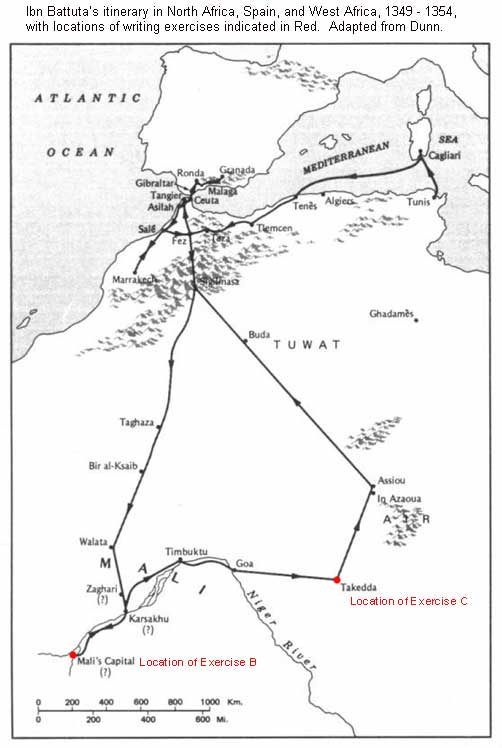
Where in the World?: Exercise A,B, and C follow Ibn Battuta in West Africa. You can see a map of the region here, with the location of the various quotation exercises indicated.
2
Questions for Exercise A:
1) Dunn uses both direct and indirect quotations.
Identify one example for each from Dunn's text. If you are uncertain
of the distinction between direct and indirect quotations, see here.
(Remember as you write papers in college, that even
indirect quotations require
citations.)
2) Identify in Dunn's second paragraph both his
claim and his warrant
Exercise
B
| Want to Know more? |
| you can read & search the whole book on-line here |
Read the following explanatory passage from Dunn, then answer the question regarding the excerpt from Ibn Battuta.
In the passage below from p. 294 of The Adventures of Ibn Battuta, Dunn describes the relationship between Islam, the ruling elite, and the larger population in the region of Mali in Africa visited by Ibn Battuta:
Sudanese chiefs and petty kings are known to have converted to Islam as early as the tenth or eleventh centuries. Whatever purely religious feelings may have motivated such men individually, conversion enhanced their esteem among Muslim merchants, the economically most powerful group in the land, and potentially tied them to a much wider commercial and diplomatic world than they had known before.
Yet the military and political success of the mansas (rulers) also depended on their continuing allegiance and cooperation of the mass of their subjects -- farming, fishing, and herding people who for the most part adhered to ancient animistic beliefs and rituals, not Islam. Unlike the sultans of Delhi [(see our textbook, pp. 19 - 21)], the mansas had not come to power as foreign invaders, prepared to organize a state as formally Islamic as they pleased. The legitimacy of their authority rested to a large extent on satisfying traditional ...expectations in their public conventions and ceremonies. Consequently, they were obliged to walk a narrow line between their urban Muslim subjects, who wanted them to behave up to the public standards of [cosmopolitan Cairo or Damascus], and the vast majority of the tax- and tribute-paying population, which took no notice of [the stricter legal dictates] of [sharia] or proper procedure of Friday Prayer.
Keeping in mind the discussion
above by Dunn (a historian), read the passage below written by Ibn
Battuta himself more than six centuries ago and look for descriptive
words or phrases that give you clues about Ibn Battuta's opinions.Then,
use this excerpt to help you answer the question that follows the
passage.
Ibn Battuta writing on a public ceremony in Mali: (this scene also
appears in this youtube video;
if you are having trouble understanding the language below, the video
can help clarify things):
[The sultan] has a lofty pavilion, of which the door is inside his house, where he sits for most of the time. . . . There came forth from the gate of the palace about 300 slaves, some carrying in their hands bows and others having in their hands short lances and shields. . . Then two saddled and bridled horses are brought, with two rams which, they say, are effective against the evil eye. . . . Dugha, the interpreter, stands at the gate of the council-place wearing fine garments of silk brocade and other materials, and on his head a turban with fringes which they have a novel way of winding. . . . The troops, governors, young men, slaves, the Masufa, and others sit outside the council-place in a broad street where there are trees...[They] are the humblest of people before their king and the most submissive towards him. They swear by his name, saying: “Mansâ Sulaymân kî.” When he calls to one of them at his sessions in the pavilion which we have mentioned the person called takes off his clothes and puts on ragged clothes, and removes his turban and puts on a dirty shâshiyya, and goes in holding up his garments and trousers half-way up his leg, and advances with submissiveness and humility. He then beats the ground vigorously with his two elbows. . . . Inside the council-place beneath the arches a man is standing. Anyone who wishes to address the sultan addresses Dugha and Dugha addresses that man standing and that man standing addresses the sultan. If one of them addresses the sultan and the latter [the Sultan] replies, [the person before the Sultan] uncovers the clothes from his back and sprinkles dust on his head and back, like one washing himself with water. I used to marvel how their eyes did not become blinded. . .This is good manners among them.
 Useful
Hints ! Useful
Hints ! |
| think about what was sufficiently different, surprising, or remarkable in Mali for Ibn Battuta that he felt compelled to describe it. Look for words that suggest he finds what he is viewing as outside his cultural experience. Remember that Ibn Battuta thought of himself as having lived a proper Muslim life in his birth place Morocco. Ibn Battuta's word choice will also be useful in writing your warrant |
Write a paragraph that responds to this question:
USING ONLY THE EVIDENCE FROM IBN BATTUTA, how can the evidence be interpreted to demonstrate that the rulers of Mali tempered their Islamicism with local West African cultural practices?
(you should NOT use evidence or information from any other source; limit your analysis to what can be extrapolated from Ibn Battuta's words -- everything you need is there, I promise. Do not use evidence from Dunn.)
Some writing instructions:
1) Your paragraph should begin with your claim, followed by evidence from Ibn Battuta in the form of direct quotations, and end with a warrant that explains how the evidence is relevant to your claim.
2) Your quotation(s) from
Ibn Battuta should be no more than 10 words and preferable MUCH shorter
-- if you are unsure how to omit unnecessary information from
a quotation, see here. (very
useful)
3) Be sure to explain to your
reader in your warrant why you think you know that a specific practice
is of local origin or not (see hint
in box to right).
4) You must label
your claim/evidence/warrant structure: put a (CL) before your claim,
a (EV) before your evidence, and a (WA) before your warrant.
5) Make
sure your warrant explains how and why your evidence demonstrates
your claim; your warrant should NOT merely
repeat your claim. 75% of
your score for Exercise B will be based on the strength of your warrant.
6) If you want to see an example from a student paper of a paragraph organized around Cl/EV/WA, see here.
Below is one way
sample you might organize this paragraph. You are, however, obviously
free to organize your paragraph in any way that makes sense to you.
The "____" in the text indicates where you would supply
your own writing on that topic. Likewise, (cl),(ev),
(wa) are the tags identifying what follows
as the claim, evidence, or warrant for the paragraph. You will want
to include such tags in your own paragraph.
| Note: if you don't identify your claim/evidence/warrant, you risk losing points for this activity |
(cl)Ibn Batuttuta found in Mali rulers who integrated local West African
cultural practices into their practice of Islam. (ev)For example, Ibn Battuta wrote___put evidence here__________________. We can conclude that such rituals were of local Malian rather than Islamic origin because____put warrant here_______________.
CHECK YOUR OWN WORK BEFORE FRITZ GRADES IT!: Ask yourself if your warrant explains HOW and WHY your evidence demonstrates your claim. Remember that 75% of your grade here depends on the quality of your warrant
Exercise C:
Background: On February 27, 1353, Ibn Battuta left the court of Mansâ Sulaymân described above and headed to the African city of Timbuktu (not yet the famous site of learning revealed in these ancient manuscripts). There, he boarded a canoe with his small camel, and traveled the famous African river, the Niger, to Goa, where the local commander presented him with a young slave boy as a gift. From Goa, he traveled to the oasis town of Takadda by land (see map).
Read the passage below by Ibn Battuta from his accounts and answer the question that follows.
The people of Takadda carry on no business but trading. Every year they travel to Egypt and bring from there everything there is in the country by way of fine cloths and other things. For its people ease of life and ample condition are supreme; they vie [vie: verb, meaning to compete] with one another in the number of male and female slaves they own—as likewise do the people of Mali and Iwalatan. They do not sell educated women-slaves, except very rarely and at a great price.…There is a copper mine outside Takadda. The people dig for it in the earth, bring it to the town, and smelt it in their houses. This [difficult work] is done by their male and female slaves. When they have smelted it into red copper, they make it into rods about the length of a span and a half: some are of fine gauge and some thick. The thick are sold at the rate of four hundred rods for a mithqal [A unit of weight, equivalent to a little over 3 1/2 grams, used in reference to quantities of gold or silver for various purposes] of gold, the fine for six or seven hundred to the mithqal it is their means of exchange. They buy meat and firewood with the fine rods: they buy male and female slaves, millet, ghee, and wheat with the thick. Copper is carried from there to the city of Kubar (Gobir) in the land of the unbelievers, to Zaghay and to the country of Barnu (Bornu) which is at a distance of forty days from Takadda. Its people are Muslim; they have a king whose name is Idris, who does not appear before the people nor speak to them except from behind a curtain. From this country are brought beautiful slave women and eunuchs and heavy fabrics.
| Useful
Hints ! |
| (A)
By social prestige value,
I mean here the ways in which holding enslaved persons was thought
to bring prestige to their owners, in the same way that some people
now believe owning an expensive car or expensive jewelry brings
social status or prestige (B) by economic function, I mean the role slaves played in the production of goods that could be sold on the marke |
Write a paragraph that
responds to this question:
How can the evidence from Ibn Battuta above be interpreted to demonstrate the economic function as well as the social prestige value of slaves within many West African societies at this time?
Some writing instructions:
1) Your paragraph should
begin with your claim, followed by evidence
from Ibn Battuta in the form of direct
quotations, and end with a warrant that
explains how the evidence is relevant to your claim.
2) Your quotation(s) from
Ibn Battuta should be no more than 10 words and
preferable MUCH shorter -- if you are unsure how to omit unnecessary
information from a quotation, see here.
(very useful)
3) Finally, you
must label your claim/evidence/warrant structure: put a (CL) before
your claim, a (EV) before your evidence, and a (WA) before your warrant.
4) Make
sure your warrant explains how and why your evidence demonstrates
your claim; your warrant should NOT merely
repeat your claim. 75% of
your score for Exercise C will be based on the strength of your warrant.
If you want to see an example from a student paper of a paragraph organized around Cl/EV/WA, see here.
| Note: if you don't identify your claim/evidence/warrant, you risk losing points for this activity |
Below
is one way sample you might organize this paragraph. You are, however,
obviously free to organize your paragraph in any way that makes sense
to you.
The ____ in the text below indicates where you would supply your own
writing on that topic. Likewise, (cl),(ev),
(wa) are the tags identifying what follows
as the claim, evidence, or warrant for the paragraph. You will want
to include such tags in your own paragraph.
(cl) From Ibn Battuta's writing we can conclude that slaves not only served
an economic function by ______(put slaves' economic function
here)____, but also served a social function by ____(put slaves' social
prestige value here)_____. Ibn Battuta presented evidence as to the
economic role of slaves when he noted that in Takadda (ev)
______(put quotation "A" here)___. We can know from this the economic
role of slaves from this because,(wa) _____(put warrant for quotation "A"
here )____ (ev) But slaves also served a social function. Ibn Battuta observed
CHECK YOUR OWN WORK BEFORE FRITZ GRADES IT!: Ask yourself if your warrant explains HOW and WHY your evidence demonstrates your claim. Remember that 75% of your grade here depends on the quality of your warrant. the social prestige ownership of slaves brought their masters when
he observed, ___(put quotation "B" here)___. (wa)____(put warrant
for quotation "B" here)______.
Postscript: According to his travel narrative, on September 11th, 1353 (almost exactly 651 years ago andnearly a century before the first European voyage to the West African coast) Ibn Battuta left Takadda in the company of a large camel caravan transporting 600 enslaved African women for what is now the African country of Morocco. Those slaves probably originated in the savanna lands south of Takadda. This region lacked the copper of Takadda and so the inhabitants traded extensively in enslaved persons to acquire the goods they desired. Once in Sijilmasa or Fez, the enslaved women would likely be sold into service as either domestic or sexual slaves (Islamic law permits men to own sexual slaves -- sometimes mistakenly referred to in in the West as "concubines" -- in any number; however, this practice is exceedingly rare now and generally outlawed in Muslim countries) for the urban elite in those African cities.
"END OF ASSIGNMENT"